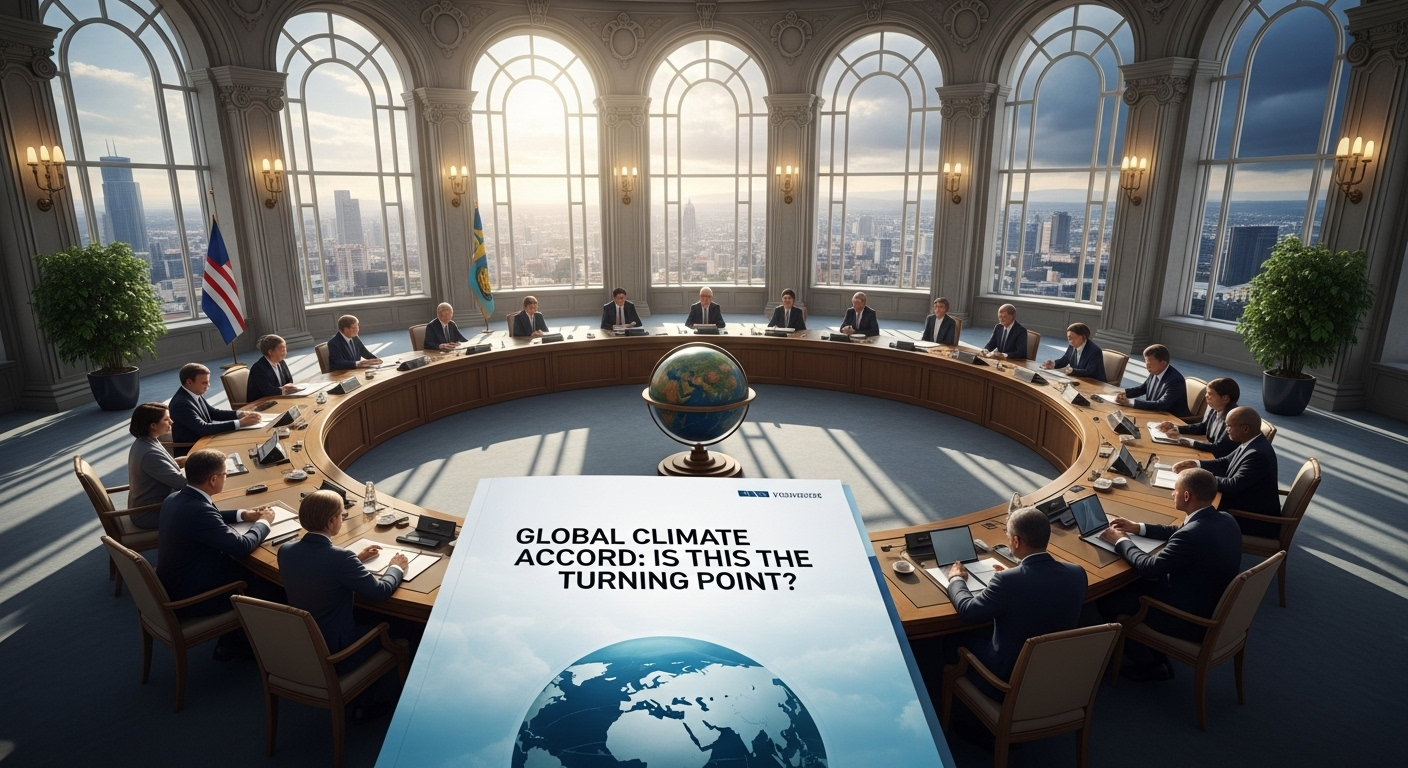
Okay, let’s be real. Climate change. It’s the elephant in every room, at every dinner party (virtual or otherwise), and frankly, I’m tired of just talking about it. But can you blame me? We’ve been “talking” for decades, and while awareness is up, actual meaningful action? Well, that feels a bit more like a toddler taking baby steps when we need a marathon runner. The Global Climate Accord—or, as it’s more formally known, the Paris Agreement—is it actually the turning point we desperately need? Or just another well-intentioned piece of paper destined to gather dust?
I initially thought it was just another round of empty promises. You know, politicians making grand pronouncements while simultaneously cozying up to big corporations who are, shall we say, less than enthusiastic about green initiatives. But… I’ve spent a bit of time digging into it, talking to some folks in the know, and actually, there’s more to it than meets the eye.
Here’s the thing: the Paris Agreement isn’t perfect. No international agreement ever is. It’s a compromise, a delicate balancing act between competing national interests. But it does establish a framework. A set of goals, accountability mechanisms, and a commitment to cooperation that, frankly, we haven’t seen before on this scale.
The Paris Agreement: More Than Just Hot Air?

Let’s break it down. The core goal is to limit global warming to well below 2 degrees Celsius, preferably to 1.5 degrees Celsius, compared to pre-industrial levels. Sounds good, right? But how do we get there? That’s where the “Nationally Determined Contributions” (NDCs) come in. Each country sets its own targets for reducing emissions, and these are updated every five years. This is where things get… interesting.
See, the initial NDCs weren’t nearly ambitious enough to meet the 1.5-degree target. Not even close. According to The UN Climate Change Website, Current pledges put us on track for something closer to 2.7 degrees of warming, which, according to the scientific community, would mean catastrophic consequences. More extreme weather events. Rising sea levels. Widespread food shortages. Basically, the apocalypse, but slightly slower.
And the question becomes: are they doing enough now? Or will we be on track for doomsday in a few years?
But – and this is a crucial but – the Paris Agreement also includes a “ratchet mechanism.” This means countries are expected to increase their ambition over time. It’s not a one-and-done deal. It’s an ongoing process of improvement and adjustment. The ideal situation would be more parties willing to join in the future. That can certainly help mitigate current climate problems.
Accountability and Transparency: Are We Really Walking the Walk?
Okay, so we have goals. But how do we ensure countries are actually meeting them? That’s where the transparency framework comes in. Countries are required to regularly report on their emissions and progress towards their targets. There’s also a process of international review to assess whether these targets are ambitious enough and whether countries are on track to meet them. Basically, it’s about shining a light on the laggards and holding them accountable.
Speaking of light, I recently read this article on solutions journalism and found it pretty inspiring. Check it out: Building a Better Future. It helps to know some people are thinking about positive solutions!
Now, the big question: does it actually work? Well, that’s still up for debate. The transparency framework is relatively new, and it remains to be seen how effective it will be in actually driving down emissions. There’s also the issue of enforcement. The Paris Agreement doesn’t have any real teeth. There are no legally binding penalties for countries that fail to meet their targets. It relies primarily on moral persuasion and international pressure. Which, let’s be honest, can be a bit hit-or-miss.
The Role of Technology and Innovation in a Warming World
This is the part I find genuinely exciting! Even better than my morning cup of joe, if you can believe it. While political agreements and international cooperation are crucial, ultimately, solving the climate crisis will require technological breakthroughs. Think about it: renewable energy sources that are cheaper and more efficient than fossil fuels. Carbon capture technologies that can suck CO2 straight out of the atmosphere. New materials and manufacturing processes that are far less energy-intensive. And maybe someday, electric vehicles will be the norm. That’s certainly something to strive towards.
I remember when I first heard about carbon capture technology. It sounded like something straight out of a sci-fi movie. But it’s real. Companies and researchers are actively working on developing and deploying these technologies, and the potential is enormous. The frustrating thing about this topic, however, is how slow it can feel. Innovation takes time, and deployment takes even longer. We don’t have decades to wait for these technologies to mature. We need them now.
That means governments need to invest heavily in research and development. They need to create incentives for companies to adopt these technologies. And they need to foster a culture of innovation that encourages risk-taking and experimentation. Because, let’s face it, solving the climate crisis is going to require some serious out-of-the-box thinking.
And hey, speaking of vehicles, have you seen the reviews for the Toyota Corolla Touring Sports? Hybrid technology is really taking off. Check out this review: Toyota Corolla Touring Sports.
You know, sometimes I think about how many people could save money playing games online instead of increasing global warming emissions by driving. I even saw this awesome game with fire and water, if we want a good analogy for global warming…
Global Climate Accord: Is this Really the Turning Point?
So, back to the original question: is the Global Climate Accord the turning point we’ve been waiting for? My answer? It’s complicated. It’s not a magic bullet. It’s not a guaranteed solution. But it is a necessary step. It provides a framework for international cooperation. It sets ambitious goals. And it creates a mechanism for accountability and transparency. But the real turning point will come when we see real, meaningful action on the ground. When countries start actually reducing their emissions. When companies start investing in clean technologies. And when individuals start making conscious choices to reduce their carbon footprint. That’s when we’ll know we’re truly on the right track.
Look, I’m not going to lie. I have moments of deep, existential dread about the climate crisis. It feels overwhelming. Insurmountable, even. But then I see stories of innovation, of communities coming together to build a more sustainable future, and I feel a glimmer of hope. A sense that maybe, just maybe, we can pull this off.
FAQ: Understanding the Global Climate Accord
Why should I even care about the Global Climate Accord?
Because climate change impacts everything. From the food you eat to the air you breathe to the stability of the global economy, it’s all connected. The Global Climate Accord represents a collective effort to mitigate those impacts and create a more sustainable future for everyone. Think of it as a global insurance policy – a way to protect ourselves and future generations from the worst effects of climate change.
How does the Global Climate Accord affect my day-to-day life?
Indirectly, in many ways. It influences government policies, investment decisions, and technological innovation, all of which impact your life. Over time, it could lead to cleaner energy, more sustainable products, and a healthier environment. More directly, the accord (and related policies) can impact energy prices, transportation options, and even the types of jobs available in your community.
Isn’t the Global Climate Accord just a bunch of empty promises? I hear a lot of talk but see little action.
That’s a fair concern! There’s definitely a gap between commitments and action. The accord relies on countries setting their own targets and holding themselves accountable. However, the transparency framework and the “ratchet mechanism” (the expectation that countries will increase their ambition over time) are designed to address this issue. It’s not perfect, but it’s a step in the right direction. Constant vigilance and public pressure are key to ensuring countries follow through on their promises regarding the Global Climate Accord: Is This the Turning Point?
What happens if a country doesn’t meet its commitments under the agreement?
This is the tricky part. There are no legally binding penalties. The Paris Agreement relies primarily on moral persuasion and international pressure. If a country fails to meet its targets, it faces reputational damage and potential diplomatic consequences. Other countries may be less willing to cooperate with them on other issues. Ultimately, the effectiveness of the agreement depends on the collective will of the international community.
What role does technology play in achieving the goals of the Global Climate Accord?
A HUGE role. Many experts would argue, perhaps the biggest role. Technological innovation is essential for developing cleaner and more efficient energy sources, capturing carbon emissions, and adapting to the impacts of climate change. The Paris Agreement encourages countries to invest in research and development and to share best practices for deploying these technologies. Without technological breakthroughs, achieving the ambitious goals of the agreement will be exceedingly difficult.