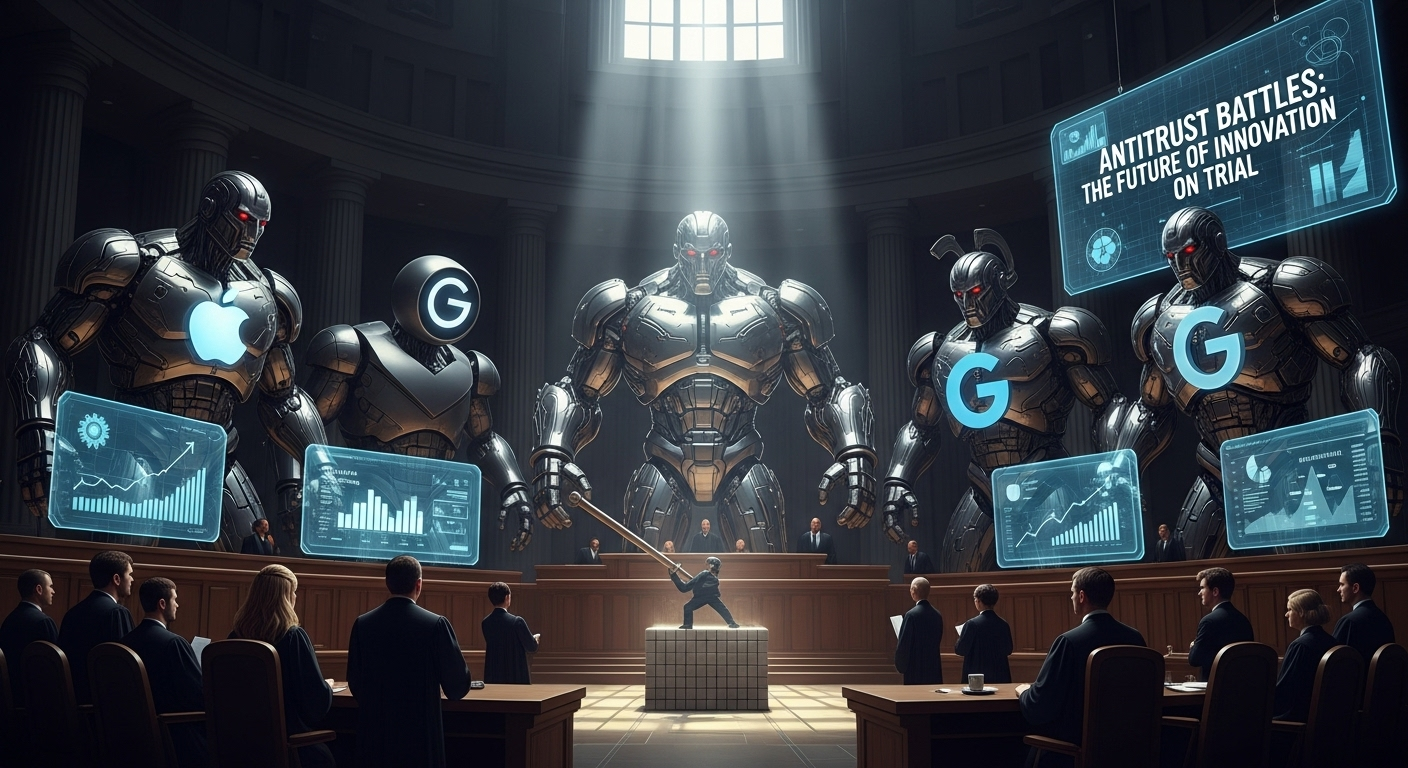
Ever feel like you’re living in a digital Wild West, except instead of cowboys and saloons, it’s tech moguls and algorithms calling the shots? I do. And the sheriffs—well, the regulatory bodies—are finally starting to ride into town, guns (lawsuits) blazing. We’re talking about antitrust battles against the tech giants. It’s a showdown that could reshape the future of innovation itself. Or maybe, just maybe, it’s a lot of sound and fury signifying… not all that much. That’s the frustrating thing; predicting the future is tricky.
The scope of these battles? Huge. Think multi-billion dollar fines, demands to break up companies, and fundamental shifts in how these companies operate. But what does it all mean for you, me, and the next generation of startups? Let’s dive in, shall we?
The Giants Under the Microscope: A History of Antitrust Actions

This isn’t exactly new territory. Remember Standard Oil? Yeah, way back when (late 19th, early 20th century), they controlled almost the entire oil industry. Then the government stepped in with antitrust laws. Standard Oil was eventually broken up, setting a precedent for future actions.
Fast forward to today. Instead of oil, we’re talking about data, algorithms, and digital platforms. But the core issue remains the same: the potential for a company to stifle competition and innovation by wielding too much power. The European Union has been particularly aggressive, slapping Google with massive fines for anti-competitive practices. The US? Well, they’re playing catch-up, but the stakes are just as high.
And it’s not just about fining companies; sometimes it’s about forcing them to change their behavior. Think about Microsoft in the late 90s. Remember that whole “Internet Explorer” debacle? The courts ruled that Microsoft had used its dominance in the operating system market to unfairly promote its browser. The result? A more level playing field (at least for a while).
The Impact on Innovation: Stifled or Spurred?
Here’s the million-dollar question (or, considering the companies involved, maybe the billion-dollar question): do these antitrust battles actually help innovation? Some argue that breaking up tech giants could unleash a wave of creativity. Smaller, nimbler companies, freed from the shadow of their behemoth competitors, would be able to experiment and disrupt the market. Makes sense, right?
But actually, that’s not quite right. There’s another side to this coin. These tech giants invest huge sums of money in research and development. They have the resources to take on ambitious projects that smaller companies simply can’t afford. Think about AI, space exploration, or even just developing the next generation of smartphones. If you hamstring these companies, are you also stifling their ability to innovate? It’s a tough question.
And here’s something even more interesting. Sometimes, the threat of antitrust action can encourage innovation. Companies might be more willing to take risks and explore new markets if they know that they’re being watched. Think of it as a kind of creative pressure.
But then again, there’s the risk of overregulation. Companies could become so worried about running afoul of antitrust laws that they become paralyzed, afraid to make any bold moves. It’s a delicate balance, to say the least. It’s something regulators are trying to walk this tightrope.
Navigating the Complexities: A Look at Specific Cases
Let’s look at specific cases, shall we? One of the most talked-about involves Apple and its App Store. Developers have long complained that Apple’s control over the App Store gives it an unfair advantage. They argue that Apple charges excessive fees, restricts competition, and favors its own apps. You might be wondering, what’s the big deal? Well, for some developers, the App Store is their primary source of revenue. If Apple takes too big of a cut, or if it unfairly promotes its own apps, it can put these developers out of business.
Then there’s Amazon. The Department of Justice has recently filed a major lawsuit accusing Amazon of illegally maintaining monopoly power through a series of anti-competitive strategies. Think about it this way: Amazon is both a marketplace and a seller on that marketplace. They control the rules of the game, but they’re also playing the game themselves. Is that fair? The DOJ seems to think not.
And who could forget Meta? From privacy concerns to acquisitions, they’ve been under scrutiny for a while. Metaverse or not, it seems to be a neverending story.
These cases are complex and have far-reaching implications. They raise fundamental questions about the role of tech giants in our society, and the extent to which they should be regulated. I keep coming back to this point because it’s crucial.
The frustrating thing about this topic is there’s not one answer. There are different legal arguments to consider here.
The Future of Innovation: A Call for Balanced Regulation
So, what does the future hold? I wish I had a crystal ball, but alas, I don’t. But here’s what I think: we need a balanced approach to regulation. We need to ensure that tech giants are not stifling competition, but we also need to avoid creating a regulatory environment that stifles innovation. It’s a tough balancing act.
We also need to think about the global implications of these antitrust battles. The tech industry is global, and so are the challenges. We need international cooperation to ensure that these companies are held accountable, no matter where they operate.
And perhaps most importantly, we need to have a serious conversation about the values that we want to see reflected in the tech industry. Do we want a future where a few powerful companies control our access to information and technology? Or do we want a more open, competitive, and innovative ecosystem? The choice is ours. I’ve got to admit, this part fascinates me.
Here’s another thing: We cannot simply assume that regulatory bodies are inherently good. There is plenty of discussion to be had about the actual impacts on innovation and the markets as a whole.
By the way, speaking of innovation, have you heard about this one online gaming site, Poki? There is definitely innovation to be seen there.
Oh, by the way, you should also take a look at this.
FAQ: Antitrust and Tech Giants
Why are tech giants facing so many antitrust lawsuits?
Good question! It basically boils down to concerns that these companies have become too powerful and are using that power to stifle competition and innovation. They are scrutinized for potentially engaging in practices that limit consumer choice, harm smaller businesses, and create monopolies.
How do antitrust battles affect the average person?
You might not think antitrust cases directly affect you, but they do! If a company has too much power, they can raise prices, reduce quality, or limit innovation. Antitrust actions aim to prevent these scenarios, ultimately leading to more choices, lower prices, and better products for consumers. Think about it this way: a competitive marketplace keeps everyone honest.
What is the difference between a monopoly and a dominant market position?
These terms are often used interchangeably, but there’s a subtle difference. A monopoly is when a single company controls an entire market. A dominant market position is when a company has a significant share of the market, giving it considerable influence. Both can raise antitrust concerns, but regulators are often more concerned with monopolies.
How might antitrust actions against tech giants affect Tech Giants Under Fire: Antitrust Battles and the Future of Innovation?
That’s the big question, isn’t it? The hope is that these actions will level the playing field, allowing smaller companies to compete and innovate. This could lead to new products and services, more competition, and ultimately a more dynamic tech industry. The fear, of course, is that overregulation could stifle innovation and make it harder for even successful companies to grow. No one wants that, and a careful balance is the key to keeping the gears greased.
What are some common misconceptions about antitrust laws?
One common misconception is that antitrust laws are meant to punish successful companies. The goal is not to punish success, but to ensure that success is achieved through fair competition, not through anti-competitive practices. In the best of all worlds, we want to encourage companies to create great things, but without tipping the balance.